Home and Community-Based Services (HCBS)
New Animated Videos Explain HCBS Final Rule!
Tri Counties Regional Center has partnered with a Hollywood studio to create a “network quality” animation series for the people served by the regional centers and the vendors who provide services to them and their families.
The result of this unique collaboration effort are 20 unique, funny, and charming five-minute shorts that clearly explain the Home & Community Based Services (HCBS) Final Rule requirements to the people receiving Regional Center services, their families and the state’s service provider community, together a population of over one million people. ELARC is proud to have contributed funding to this project.
View the Animated Videos by categories below.
These series are also available via comic books. To receive a free copy of one or more comic book(s) please e-mail Karen Sibrian at kasibrian@elarc.org and coordinate a date and time to pick it up.
For People Receiving Services
For People Receiving Services (English)
For People Receiving Services (ASL Version)

For People Receiving Services (Spanish)
For Service Providers
For Service Providers (English)
For Service Providers (ASL Version)

For Service Providers (Spanish)
What is the Home and Community-Based Services (HCBS) Final Rule?
View the HCBS Final Rule Fact Sheet(PDF, 386KB)
The purpose of the rules is to ensure that individuals receive services in settings that are integrated in and support full access to the greater community. This includes opportunities to seek employment and work in competitive and integrated settings, engage in community life, control personal resources, and receive services to the same degree as individuals who do not receive regional center services. It means that settings need to focus on the nature and quality of individual's experiences and not just about the buildings where the services are delivered.
Individuals have an active role in the development of their plan, the planning process is person-centered, and the plan reflects the individual's service and supports and what is important to them.
Home and community-based settings are places where individuals with disabilities live and spend their days; for example, licensed community care facilities and other residential settings and day programs. The rules explain what these settings should be like.
What Does This Mean to Me?
If you are an individual who receives services, it means that you should have different options to choose from regarding services and service providers. The focus and right is for individuals to be involved in the community; for example, shopping, attending church, dining out, employment, etc. As an individual you have rights and it is important you understand them.
Regional Center's Role
The federal government helps pay for most of the services regional centers provide to individuals with developmental disabilities. In March 2014 new federal rules became effective describing how home and community-based services are provided.
All services in every state must follow the new rules by March 2023. After March 2023, the federal government will not provide funding for services that do not meet the new rules. Assessing all services and settings and making necessary changes takes time.
Statewide Transition Plan
Heightened Scrutiny Process: The Centers for Medicare and Medicaid Services (CMS) have released updated guidance regarding the heightened scrutiny process for home and community-based services, which can be found on the CMS website(PDF, 277KB).
California drafted a Statewide Transition Plan to describe how it will move forward and ultimately achieve compliance with the new rules. Because the federal rules are new, states are being allowed some time to come into compliance. States have to assess their laws, regulations, policies, and settings where services are provided to see if they are reflective of the new rules. Each state must develop Transition Plans to describe how it will meet the new rules, how it will change the areas that do not comply, and how it will sustain the review process to assure ongoing compliance.
To view California's current proposed statewide transition plan, please view the Department of Health Care Services webpage. To view all the Statewide Transition Plans, visit the Medicaid website.
For more information please visit these websites:
For Service Providers Only
If you are a service provider, it means that you may need to make changes in how you operate in order to meet the new federal rules by modifying policies and program designs, where and how your service is delivered, and providing training to assure that your staff members understand the expectations of the rules.
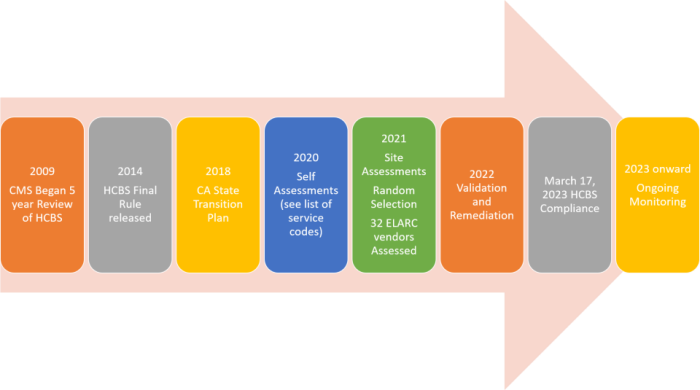
In the last few years, the focus has been on providers assessing for compliance with the HCBS Final Rule. It started in 2020 with a self- assessment, followed by a randomly selected virtual site assessment and the Validation and Remediation process. Providers were either asked to validate their self-assessments or remediate services reporting to be out of compliance. Please see letter to regional centers on May 20, 2022(PDF, 113KB).
Validation documents and/or remediation were submitted by providers and reviewed by either independent contractors (PCG) or ELARC’s internal review team. In February of 2023 ELARC's vendor community reached compliance through desk review. Providers were made aware it was the responsibility to ensure continued compliance through existing documentation (Program Designs, Policy and Procedures, Handbooks etc.) and in direct practice. In late 2023 The Department of Developmental Services (DDS), put forth a directive in support of Regional Centers(PDF, 243KB) fully implementing the federal requirements for HCBS settings. In the directive, Regional Centers are expected to complete an on-site review of all HCBS settings to verify their full compliance and implementation of the HCBS settings requirements.
ELARC has begun to connect with providers through either routine QA visits or independently for a complete HCBS monitoring review.
ELARC continues to support our providers adhere to the federal requirement of HCBS settings by making available resources to better understand, provide guidance of proper implementation in alignment with the standards in documentation, and in practice. These resources can also serve as a tool to prepare for your monitoring visit.
Community of Practice- A Virtual HCBS Community of Practice an inclusive space where we come together to learn, grow, and make a real impact. Here you will find materials that review different person-centered approaches and practical resources that you can utilize within your teams and discuss how you may apply them creatively to sustain and exceed the HCBS quality standards.
- Trainings for providers- ELARC provides ongoing training in different related HCBS focuses. Check back for 2026 training dates
- Self-Advocate HCBS trainer Academy- 2023- Self-Advocates severed by ELARC completed a HCBS academy in 2023. These experts can visit you facility or program to speak on HCBS.
- 1:1 Technical Assistance/ coaching- If you find yourself struggling in understanding or implementing practices/ policies to meet HCBS compliance then why not consult with one of our contractor and see how Technical assistance can be provided. This service can also be done through referral by your QA specialist.